 AIMemLink
Blog
'Enjoys travelling' isn't what your AI needs to know
Built-in AI memory is often system-authored, not user-authored — even when it sounds plausible. Here is why that happens and what to do about it.
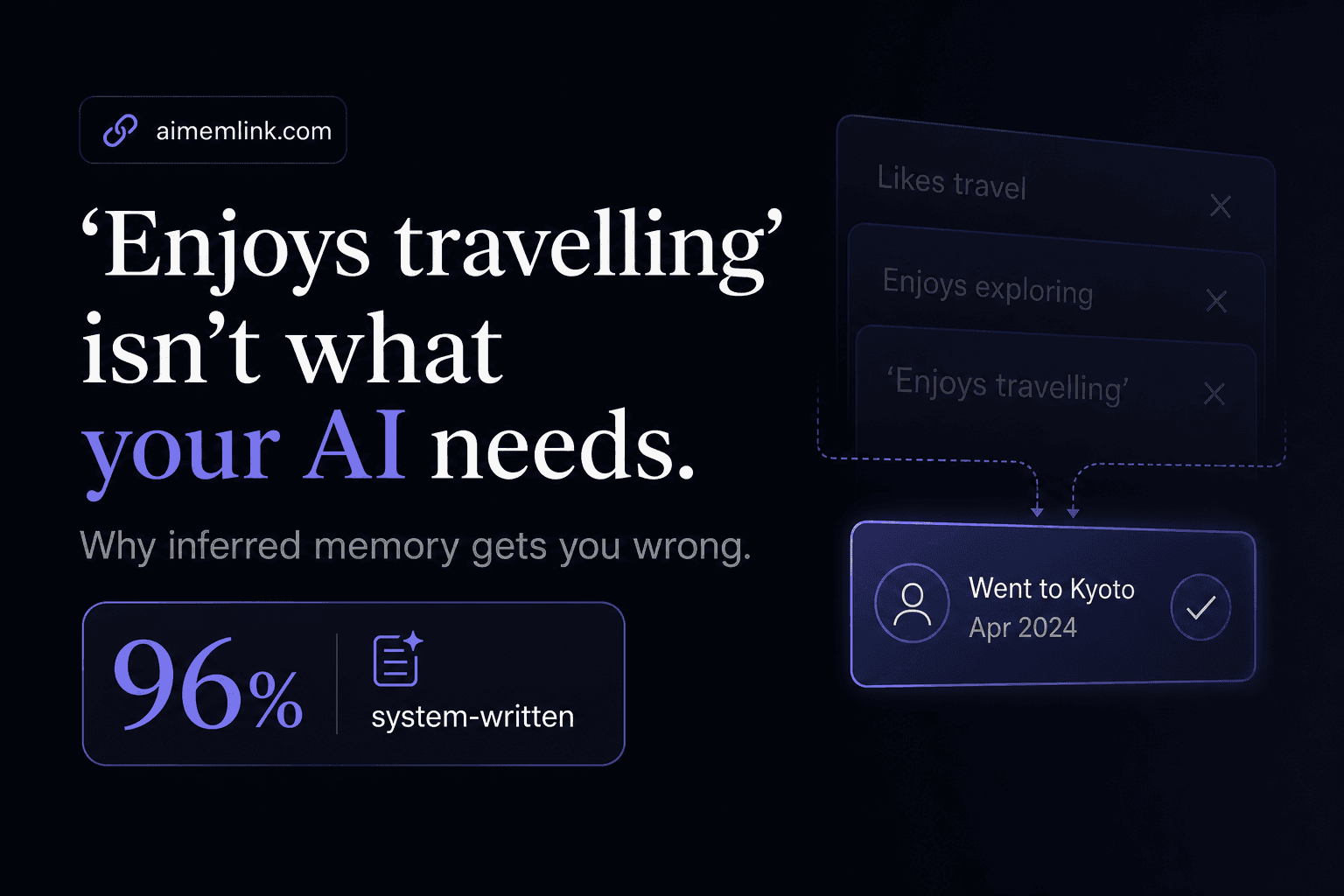
The 96% problem: who writes your AI's memory?
Researchers analyzing 2,050 memory entries from 80 real ChatGPT users (arXiv 2602.01450, accepted at ACM Web Conference 2026) found that 96%were created by the conversational system without an explicit user command to remember. Only 4% came from phrases like "remember this" or "save that."
The memories were often faithful to conversations — 84% grounded in user context — but the authorship was not yours. More than half contained sensitive psychological inferences; 28% held GDPR-defined personal data.
"Enjoys travelling" vs what you actually said
ChatGPT memory might save: "Maya enjoys travelling." What Maya would write herself: "I prefer low-cost trips, avoid long walks because of knee pain, and plan around school holidays."
The first is a plausible inference. The second is actionable context. Generic summaries produce generic advice — and miss constraints that actually change recommendations.
“Maya enjoys travelling.”
AIMemLink memory
“I prefer low-cost trips, avoid long walks because of knee pain, and plan around school holidays.”
Don't hope your AI picked up the right things. Tell it what matters.
Four ways built-in memory gets you wrong
- System-initiated inference: The model decides what is worth remembering, not you.
- Stale or contradictory entries:OpenAI documents that older memory systems "often became stale" and entries "could contradict one another."
- Wrong scope: Claude project memory does not read global memory; ChatGPT project-only memory isolates context to one workspace.
- Cross-tool drift: A correction in ChatGPT does not update Claude or Gemini. Each tool maintains its own inferred summary.
Why faithful-to-chat ≠ accurate-to-you
An AI can accurately reflect what you said in a conversation while still storing the wrong level of detail. "I went hiking last weekend" becomes "enjoys outdoor activities" — losing the knee injury you mentioned three chats ago. Psychological inferences (desires, preferences, personality traits) made up the majority of sensitive entries in the study.
What you can control today
Each vendor offers audit tools: ChatGPT's Memory Summary and saved memories list, Claude's view-and-edit memory, Gemini's activity and memory toggles. Use Temporary or Incognito modes when you do not want inference. Review quarterly — controls exist, but the default is synthesis, not authorship.
The fix: an authored personal context record
Write the context you want every AI to use — in your own words, first person, with the specifics that change recommendations. AIMemLink hosts that record as plain text at a private link. You inspect it top to bottom. You update it when life changes. The same source works across ChatGPT, Claude, and Gemini.
AIMemLink does not stop ChatGPT from inferring its own memories. It gives you an alternative source of truth you control — authored, not collected.
What to put in (and what to leave out)
Use our personal AI context file template for a privacy-first structure: standing rules, current priorities with dates, constraints, and a clear list of what not to include.
Ready to create your AI memory?
Write your context, use your private link for personal memory, and publish optional public basics when you want them discoverable by username.